One poisoned dependency shouldn't reach your customers.
Signed builds, verified dependencies and hardened pipelines aligned to SLSA, so what you ship is exactly what you built.
One call with a senior engineer. A straight answer on what it would take.
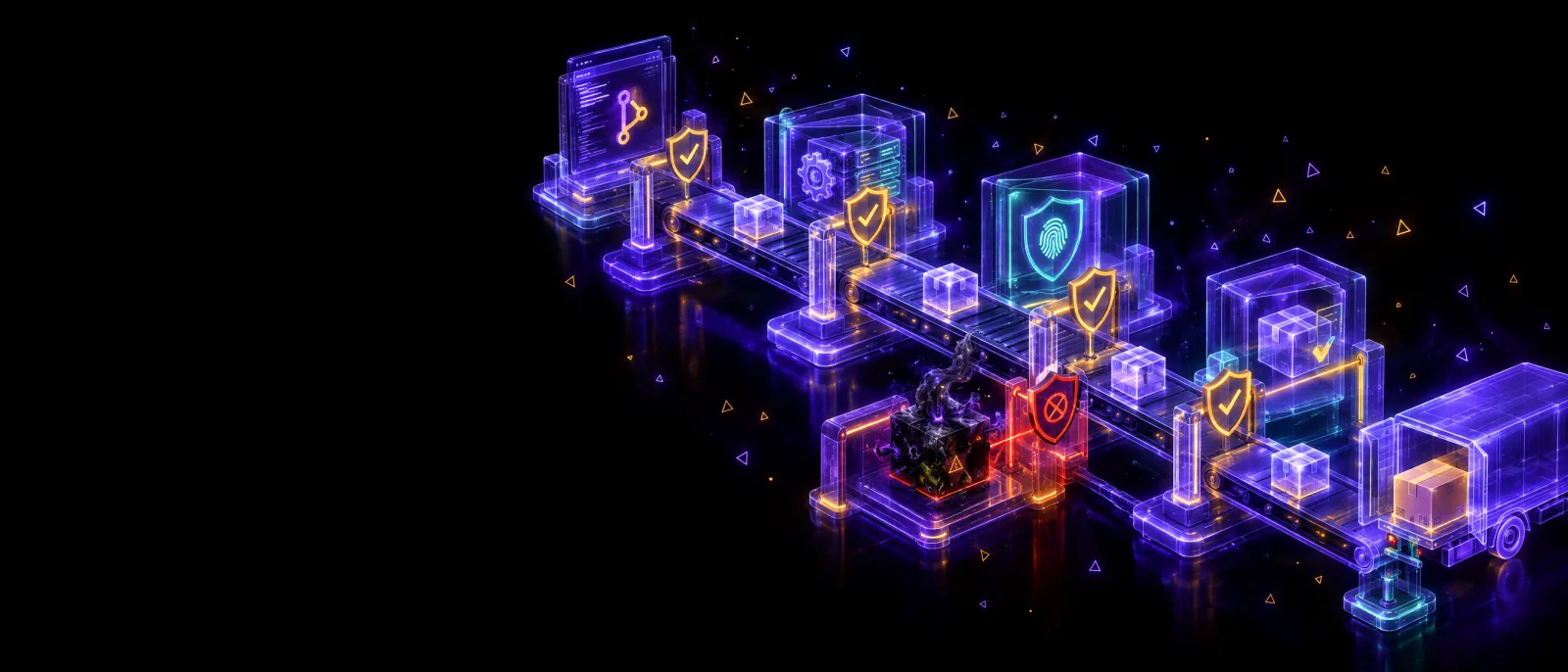
Where you are. Where you’ll be.
You need this if
- Your build pipeline has broad credentials nobody reviewed
- You depend on hundreds of open-source packages
- Enterprise customers are asking about supply-chain security
What changes for your business
- Tampered code blocked before it ships
- Proof of build integrity for customers and auditors
- Third-party and open-source risk under control
What we hand over
- Supply-chain risk assessment against SLSA
- Artifact signing and provenance attestation
- Dependency verification and private registry policy
- Admission controls that block unverified deployments
What it is
Software supply-chain integrity is assurance that the software you ship contains only what you intended, built from verified code and dependencies on trusted systems. It defends against attacks that compromise a build tool, package or pipeline, which can reach every customer through a single poisoned release.
Attackers increasingly skip the front door and compromise a build tool, a package or a CI pipeline instead. We harden the path from commit to customer: signed commits and artifacts, pinned and verified dependencies, isolated build environments, provenance attestations aligned to SLSA levels, and policy that blocks unsigned code from deploying.
- Why now
- 30% of breaches now involve a third party, double the year before. Verizon Data Breach Investigations Report, 2025 (opens in a new tab)
- Last reviewed
How it runs
- 01
Diagnose
Typically 2–4 weeksWe map the problem, your data and your systems, and agree the one number that defines success.
- 02
Prove
Typically 4–8 weeksA working pilot on your real data, measured against that number. Not a slide demo.
- 03
Ship
Scoped to the outcomeProduction build with security, monitoring, cost controls and documentation included, not upsold.
- 04
Run
Ongoing, optionalWe operate what we built against clear service levels, or train your team to. Your call. No lock-in.
Questions you’ll ask
- What is SLSA?
- Supply-chain Levels for Software Artifacts, an open framework that defines increasing levels of build integrity, from documented builds to hardened, isolated and verifiable ones. It gives you and your customers a shared way to describe how trustworthy a build is.
- Why target the build pipeline?
- Because attackers increasingly compromise build tools, packages or CI credentials rather than production systems, and one poisoned build reaches every customer. Verizon's 2025 DBIR found third-party involvement in breaches doubled to 30%.
- Do we need to stop using open-source packages?
- No. You need to know which ones you use, pin and verify them, and watch them for vulnerabilities and suspicious changes. Open source stays; blind trust in it goes.
Sound familiar? Let’s fix it.
One call with a senior engineer. You’ll leave with a straight answer on what it would take.
Let's Build Together